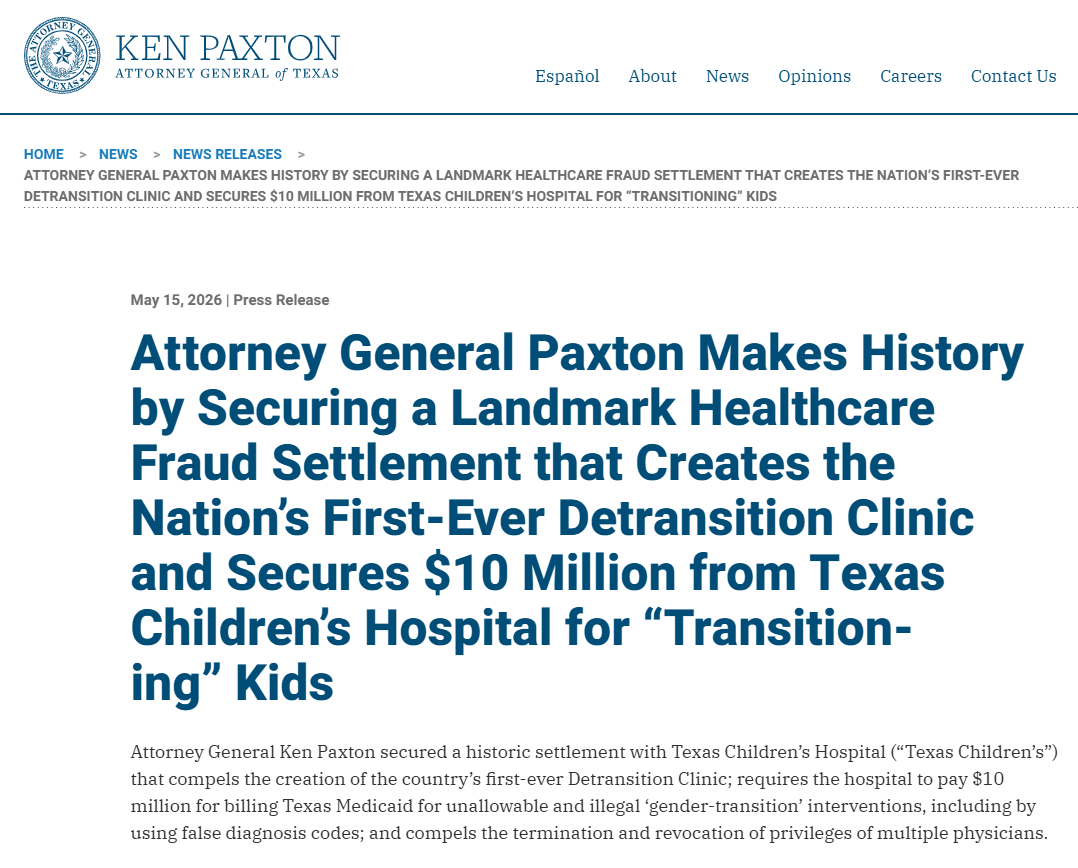
$10 Million Landmark Fraud Settlement with Texas Children's Hospital
On May 22, 2024, my attorneys filed a qui tam action in the United States District Court for the Southern District of Texas: United States ex rel. Doe v. Texas Children’s Hospital, et al., pursuant to the qui tam provisions of the federal False Claims Act, 31 U.S.C. § 3730(b), and the Texas Health Care Program Fraud Prevention Act, Tex. Hum. Res. Code § 36.101.
For two years, I waited while the federal and state government investigated my disclosures and claims. I cooperated with the government and became the relator in a state and federal qui-tam healthcare fraud investigation. My attorneys, Marcella Burke, Jeff Hall, and Patrick Kenneally were relentless and unwavering in their negotiations with the government and in their defense of me. I owe them an eternal debt of gratitude for believing in me and standing by my side every step of the way.
My decision to blow the whistle on Texas Children's Hospital helped expose alleged Medicaid fraud tied to pediatric gender-transition interventions, culminating in one of the most unprecedented healthcare settlements in Texas history. Announced by Texas Attorney General Ken Paxton in coordination with the U.S. Department of Justice, the landmark agreement requires Texas Children's Hospital providers to pay $10 million, establish the nation's first-ever detransition clinic to provide multidisciplinary care for patients seeking to reverse the effects of sex-rejecting procedures, permanently end sex-rejecting procedures for both minor and adult patients, implement sweeping compliance reforms, and revoke or permanently bar the privileges of multiple physicians involved in those sex-rejecting interventions. This settlement represents far more than a financial resolution—it establishes a new model for institutional accountability, patient care, and healthcare oversight, demonstrating how the courage of a single whistleblower can drive systemic reform and create lasting change for vulnerable children and families.

“People often ask if blowing the whistle was worth the cost. When I think about the young people who will now have free access to specialized care because someone chose to speak the truth, my answer is simple: absolutely.
If one act of courage can open the door to healing for countless lives, then every sacrifice was worth it.”
-Vanessa Sivadge
Major Outcomes of the Settlement
Permanent End to Sex Rejecting Procedures
Texas Children's Hospital and its affiliated entities agreed to permanently cease performing sex rejecting procedures—including puberty blockers, cross-sex hormones, surgical interventions, voice modification interventions, and related ancillary or preparatory care—and to cease referring, directing, recommending, coordinating, or facilitating such procedures by any third party or outside provider, whether inside or outside the Texas Children's system.
The agreement also prohibits the hospital from indirectly facilitating these procedures through affiliated entities or outside providers under its control.
This is significant because the hospital had previously denied these procedures that the settlement now requires it to remove and supersede.
This commitment extends beyond current leadership and is intended to remain in place permanently, absent a change in the law requiring Texas Children's to provide such procedures.
Physician and Staff Accountability
The settlement requires:
Permanent termination of clinical privileges for three current physicians identified in the agreement.
Permanent ineligibility for two separate former physicians to ever hold or regain privileges within the Texas Children's system.
Written warnings and counseling for providers and staff involved in the hospital's transgender program.
In addition, within 60 days Texas Children's must recommend to its medical staff an amendment to the medical staff bylaws making a violation of its prohibition on sex rejecting procedures a trigger for automatic relinquishment of clinical privileges, with no right to a hearing or appeal.
Creation of a Detransition Clinic
The clinic must provide multidisciplinary medical care for patients up to and including age 21 who previously underwent sex rejecting interventions, including:
Endocrinology
Primary care
Surgery
Fertility counseling
Psychiatry
Psychotherapy
Speech pathology
Social work and case management
For five years, these services must be provided at no cost to patients. Beyond that period, the agreement directs Texas Children's to use donations designated for the clinic to continue funding free detransition services.
Mandatory Staff Training
Every year, hospital employees must receive training covering:
Texas laws governing sex rejecting procedures
Proper medical coding requirements (required annually for all clinical staff and providers involved in coding)
Fraud prevention
Internal reporting procedures
Whistleblower protections
Legal consequences for violations
The agreement even requires employees to receive information explaining that whistleblowers may be entitled to receive a portion of funds recovered through fraud investigations.
Public Accountability
Texas Children's Hospital also agreed to issue a public statement acknowledging the following:
It performed gender-transition procedures on both minors and adults.
Previous public media statements denying these practices, including the statement posted on May 15, 2026, have been removed and superseded.
The hospital has permanently ceased providing these procedures.
That public statement must remain accessible on the hospital's website for 15 years.
Protecting Medical Records and Future Patients
The agreement contains several highly technical provisions designed to improve oversight.
Texas Children's must:
Maintain accurate biological sex information within electronic medical records.
Create secure, access-restricted patient lists covering patients previously diagnosed with gender dysphoria.
Preserve audit trails documenting access to those records.
Conduct ongoing compliance reviews to verify accurate documentation.
Maintain these oversight systems for ten years.
These requirements are intended to improve transparency and reduce opportunities for improper coding or documentation practices.